
Manage Manual and Automated Testing with GitHub Test Management Software
Your developers live in GitHub. Your testers live in Kualitee. The two-way integration keeps issues in sync between them, so a bug logged on one side lands on the other on its own. You run your test cases, defects and releases in Kualitee, and GitHub keeps doing the job your dev team already trusts it with.
Everything You Need for GitHub Test Management
A GitHub issue and a QA defect are often the same problem, written down twice. In a busy sprint, one gets updated and the other does not. A developer marks an issue fixed in GitHub while the defect still sits open in the tester's queue. Keep the two in step by hand and one of them falls behind.
Link your GitHub project to a Kualitee project and the sync does that work for you. Around it, Kualitee gives you the test management GitHub was never built for: a place for your test cases, your executions, your releases and your reporting.
GitHub Issue Synchronization
Issues and defects sync both ways. A status change, comment or label on one side updates the other.
Test Reporting
Every run becomes a report. Dashboards show where things stand without a spreadsheet.
Manual and Automated Test Management
Both kinds of testing sit in one workspace, not two tools.
Release Visibility
Check a release against its test cases, executions and open defects in one view.
Requirement Traceability
Trace a requirement to its test cases, executions and defects, in either direction.
Dashboards and Analytics
Pass and fail trends, defect status and release health, live.
Improve Software Quality with GitHub Test Management
Automatic sync means QA and development stop working from two versions of the truth. A tester logs a defect in Kualitee and it shows up for the developer in GitHub. The developer closes it in GitHub and the tester sees the update. Fewer duplicate tickets and a shorter trip from found to fixed.
- ✓ Sync GitHub issues with Kualitee defects, both directions
- ✓ Manage manual and automated tests in one platform
- ✓ Track test execution across releases
- ✓ Log and manage defects faster
- ✓ Watch software quality on live dashboards
- ✓ Keep QA and development on the same page
Centralize Testing, Defects and GitHub Workflows
Your code and your issues sit in GitHub. Your testing runs in Kualitee. The integration joins them so GitHub becomes one step in a single QA process, not a second tool your testers open on the side. Plan tests, run them, log defects and track releases in Kualitee, and the issues developers care about show up back in GitHub.
GitHub Issues Alone vs GitHub with Kualitee
GitHub issues track work well. Running a full QA process is a different job. Here is what the integration adds.
| Task | GitHub issues on their own | GitHub + Kualitee |
|---|---|---|
| Issue tracking | Tracks issues inside the repository | Same issues, synced two-way with Kualitee defects |
| Test case records | None. GitHub has no concept of a test case | Full test case repository, manual and automated |
| Defect to dev handoff | Comment on the issue, hope QA sees it | Status, comments and labels sync both ways automatically |
| Test execution history | Not tracked | Execution history and trends across builds and releases |
| Requirement traceability | None | Requirement to test to defect to release, linked |
| Release view | Milestones and labels only | Release status across test cases, executions and defects |
| Reporting | Basic issue counts | Dashboards for pass and fail trends, defects and release health |
| Who can see it | Whoever has repo access | Role-based access for QA, dev, product and auditors |
A Bug, from Test to Fix
Here is the sync on a normal day.
Tester finds and logs
A tester runs a case in Kualitee and it fails. They log a defect with the steps, the build and a screenshot. The GitHub project is linked, so that defect lands as an issue in the repository the developers already work in. Nobody emails it across.
Developer fixes and closes
The developer fixes it, pushes the change and closes the issue in GitHub with a comment. That close and the comment sync back into Kualitee, so the tester knows it is ready to verify. They retest. If it passes, the defect closes on both sides at once.
Reopens stay on one thread
If the fix does not hold, the tester retests, it fails again, and they reopen the defect in Kualitee. The reopen syncs straight back to GitHub, so the developer finds the issue live again where they closed it. The thread stays on one problem, however many rounds it takes.
Not really the sync. It's the duplicate tickets that never appear and the status pings nobody sends. Across a full release, that adds up to real hours.
Who This Is For
This integration pays off when developers and QA use different tools and burn time keeping them lined up.
See release quality in one place instead of chasing the dev team for status.
Keep their test work in Kualitee and skip the manual copy into GitHub.
Get defects as issues in the repository they already use, with the build and steps attached.
Get a QA process wired into the GitHub workflow rather than parked next to it.
A small team all watching one repository may not need it yet. The teams that feel the gap first are the ones running QA across several projects, with developers in GitHub and testers in a separate tool. The handoff between the two is where the time goes.
Keep Control of Who Sees What
The sync moves issues and defects between two tools, so access is worth thinking about. Kualitee runs on role-based permissions. A tester, a developer, a product owner and an auditor each see what their role needs, and the rest stays out of their way. Every action lands in an audit log, so when a client or a regulator asks who changed what, and when, the answer is already recorded. For teams in banking, fintech and other regulated work, that trail is part of how a release gets signed off, and it is there without anyone building it by hand.
Why Teams Choose Kualitee for GitHub Test Management
Kualitee earned 56 G2 badges in the Summer 2026 reports, across Bug Tracking, DevOps, Software Testing, Test Management and AI Software Testing Tool.
Recognized by G2
Summer 2026, across five categories including Test Management and AI Software Testing Tool.
Less manual reporting
Issues sync on their own, so bugs stop getting copied between GitHub and Kualitee.
Better test visibility
QA, developers and product read release health off the same dashboards.
Stronger collaboration
One shared view of issues and defects keeps dev and QA aligned.
How the GitHub Integration Works
Connect GitHub
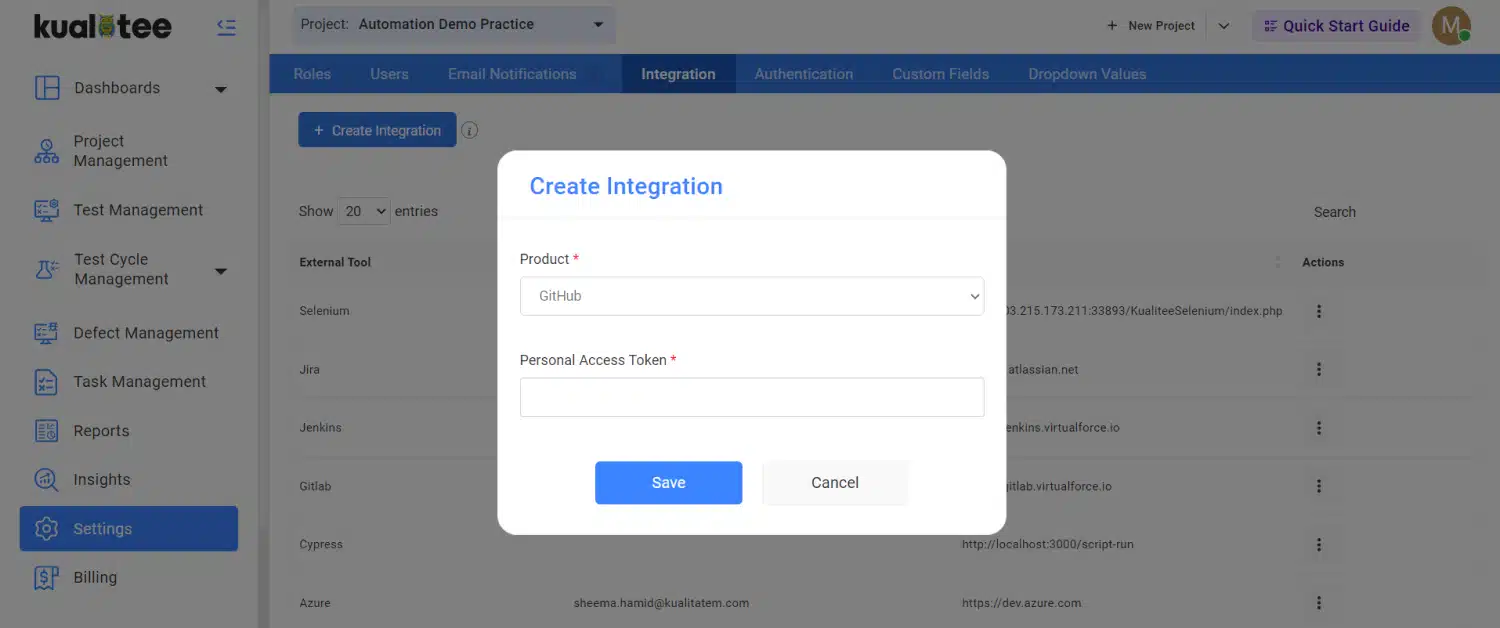
In Kualitee, open Settings and select Integration. Choose Create New, pick GitHub and enter your GitHub Personal Access Token. You need admin access in both tools. Save to confirm.
Link Your Projects
Link a GitHub project to a Kualitee project. That sets up the two-way sync between GitHub issues and Kualitee defects.
Sync Issues Automatically
Once linked, the issues stay in sync. A status change, a new comment or a label update on one side appears on the other.
Monitor Software Quality
Manage test cases, track executions, log defects and follow release quality from one dashboard in Kualitee.
Key Features of GitHub Test Management Software
GitHub Issue Synchronization
Issues and defects stay aligned both ways, including status, comments and labels.
Unified Test Management
Manual and automated testing in one workspace.
Test Automation Support
Direct support for Selenium, Playwright and Appium, with results tracked in Kualitee.
Test Reporting
Execution reports and dashboards for every run.
Requirement Traceability
Requirements linked to test cases, defects and releases, end-to-end.
CI/CD Ready
Kualitee fits a CI/CD workflow and connects to Jenkins pipelines for automated execution reporting.
Team Collaboration
Developers in GitHub, QA in Kualitee, both on the same issues.
Enterprise Security
Role-based permissions, audit logs and secure collaboration.
Frequently Asked Questions
It is a test management platform that connects to GitHub, so your testing and your GitHub issues stay in sync. Kualitee handles test cases, executions, defects and releases, and its two-way GitHub integration keeps issues aligned across the two tools.
Two-way. Changes move in both directions between GitHub issues and Kualitee defects. Update a status, add a comment, or change a label on either side and the other reflects it, so neither tool holds a version the other has not seen.
Yes, both directions. Link a GitHub project to a Kualitee project and issues sync across. A status change, a new comment or a label update on one side updates the other on its own.
In Kualitee, go to Settings, then Integration. Choose Create New, select GitHub and enter your GitHub Personal Access Token. You need admin access in both tools. Save to start syncing.
Yes. Both live in the same workspace in Kualitee, next to your synced GitHub issues, so the whole QA effort sits in one place.
Selenium, Playwright and Appium have direct support. Their results are tracked in Kualitee alongside your manual tests.
Kualitee fits a CI/CD workflow. The GitHub sync keeps dev and QA aligned, and for automated test execution reporting, Kualitee connects directly to Jenkins pipelines.
Does the GitHub Integration support CI/CD?
Kualitee fits a CI/CD workflow. The GitHub sync keeps dev and QA aligned, and for automated test execution reporting, Kualitee connects directly to Jenkins pipelines.